
FOR YARDS, RIGGERS & FLEET INSPECTIONS
Rigging tension gauges for standing wire.
Match a standing-wire gauge to the cable, rig requirements and inspection record.
Published and reviewed November 1, 2026 · CTM Engineering
Cable measurement plan
Choose a review path. Confirm exact instrument fit and calibration before ordering.
Identify the cable before selecting a gauge
A diameter alone cannot identify a calibration profile. Send the cable specification or ask for an identity review.
- Record nominal and measured diameter, material, construction and coating.
- Identify the wire construction, diameter, stay/shroud ID and rig configuration.
- Use the rig designer’s target and verify the gauge scale/profile for that exact wire.
- Agree the installation procedure, error definition, reference records and acceptance criteria.
THE DECISION BEFORE THE NUMBER
A wire-size match is only the first selection check.
A spring gauge, a digital clamp and a rod instrument can all be used around a rig, but they do not share one universal scale or calibration. Confirm the material and exact gauge instructions before interpreting the reading.
Review rope-specific calibration and force units →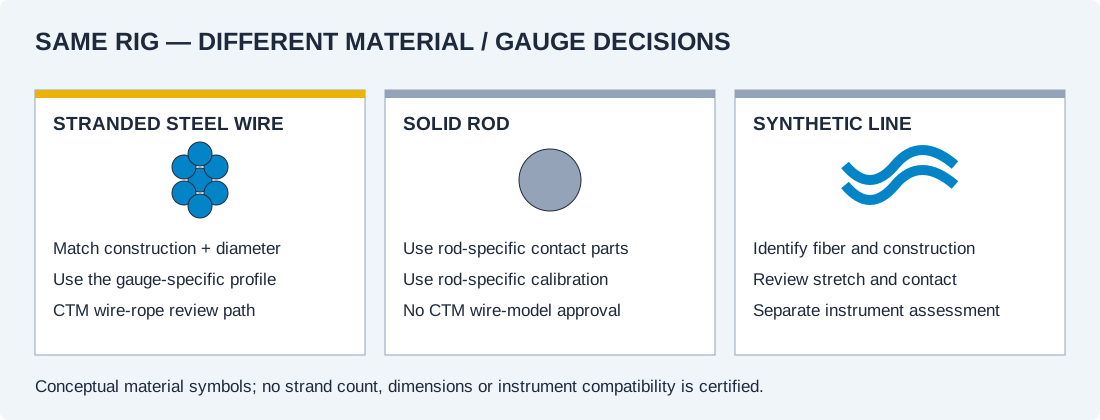
Stranded wire, solid rod and synthetic stays need separate treatment
A common sailing application does not make the materials interchangeable. The CTM wire-rope catalog supports a stranded-steel measurement review; other materials require a separate instrument decision.
| Material | Identify before ordering | Selection boundary |
|---|---|---|
| Stranded stainless steel wire | Construction such as 1x19, nominal/measured diameter, grade, coating and force range. | Review a gauge/profile explicitly calibrated for this wire; a 7x19 profile is not automatically a 1x19 profile. |
| Compact or alternative strand construction | Supplier designation and relevant construction details. | Do not assume a standard 1x19 label/chart provides the absolute force. |
| Solid rod | Rod diameter, material, terminal arrangement and dedicated gauge instructions. | Loos publishes separate RT rod gauges. No CTM stranded-wire model is approved for rod by this page. |
| Synthetic line / stay | Fiber identity, construction, cover, diameter and elongation behavior. | Seek material-specific measurement support; this steel-wire guide does not confirm compatibility. |
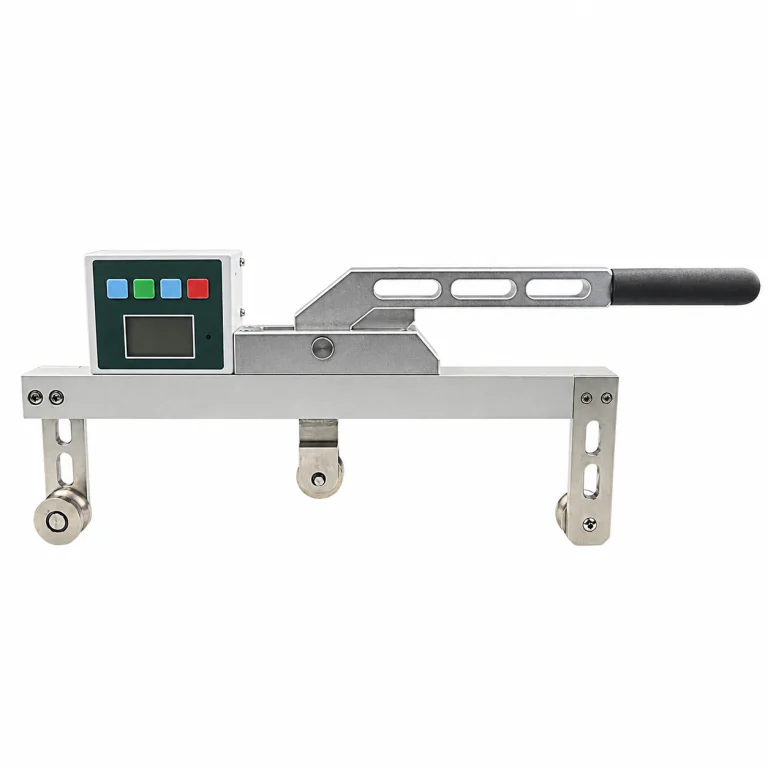
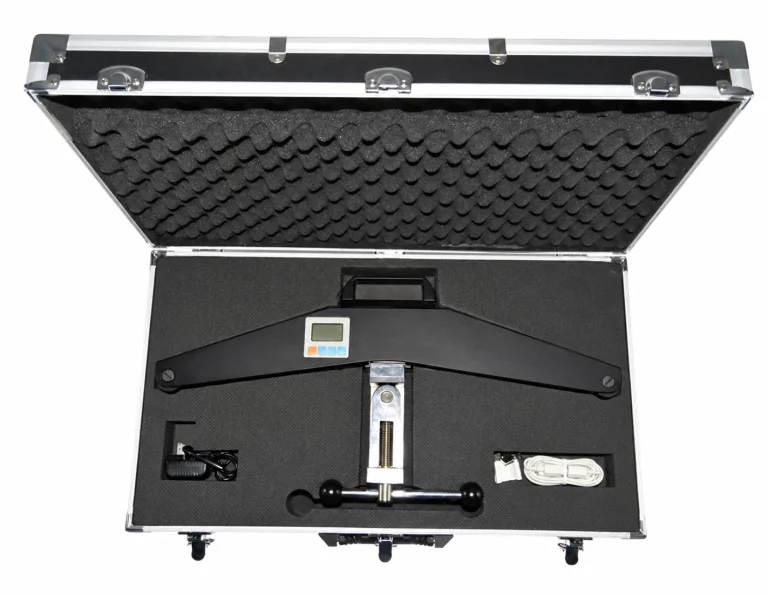
Loos professional wire-gauge sizes: preserve the exact model label
Source-specific examples from Loos INST-07, revision 06/18/19, PDF page 1, retrieved November 1, 2026. These are listed cable sizes, not continuous ranges or CTM cross-references. The cited conversion note is for 302/304 1x19 stainless wire. Other grades/constructions need explicit support. Confirm the actual gauge label, size column and current instructions.
| Loos model | Listed cable sizes | Interpretation |
|---|---|---|
| PT-1 | 3/32, 1/8, 5/32 in | Use the imperial model’s own size column and units. |
| PT-1M | 2.5, 3, 4 mm | A metric model list is not merely rounded imperial fractions. |
| PT-2 | 3/16, 7/32, 1/4 in | 7/32 in equals 5.55625 mm; that conversion does not select a metric calibration. |
| PT-2M | 5, 6, 7 mm | Match an actual supported wire size/profile. |
| PT-3 | 1/4, 9/32, 5/16, 3/8 in | Use the fitted gauge and its load/size limits. |
| PT-3M | 7, 8, 9, 10 mm | Listing follows the cited instruction revision; confirm the actual instrument documentation. |
Source scope: Loos INST-07 professional wire-gauge instructions, PDF page 1.
From the rig document to a repeatable yard record
Start with the rig document, not a universal percentage
Obtain the boat, mast or sail designer’s requirements for the particular rig. Loos’ professional-gauge instructions also direct users to the relevant manufacturer for application-specific tension requirements. This guide deliberately does not prescribe a single percentage of breaking strength for every vessel.
Keep chart conversion separate from the tuning target
The gauge chart interprets a specific instrument reading for a supported wire. The rig document determines the desired tension and acceptable condition. An inch-to-mm conversion or a new display unit cannot make a chart valid for an unsupported material or wire construction.
Match the measurement point and the whole-rig condition
Use the instrument’s contact and clearance instructions. Document where the gauge was placed and the rig condition under which the value was obtained. Comparing a loaded reading on one side with a different condition on the other can produce a misleading conclusion.
Verify data export before standardizing a fleet kit
For a digital quotation, request an actual supported app/device list and sample export. Agree how vessel IDs, member IDs, units, rope profiles and timestamps will be represented. A Bluetooth option alone does not establish report traceability or salt-water protection.
Treat inspection, adjustment and acceptance as separate steps
A reading can support a professional inspection record; it does not prove the mast, fittings, terminals or hull are sound. Follow the responsible designer or service procedure for adjustment and final acceptance. Ask for the exact instrument configuration and calibration evidence before ordering a yard kit.
A spring gauge and a digital request solve different recording needs
Choose by the job, the wire and the documentation you need. No blanket accuracy, price or brand-equivalence claim is made.
| Decision | Mechanical wire gauge | Digital clamp-on configuration review |
|---|---|---|
| Readout | May use a scale with a matched wire-size table. | Confirm displayed force units and selected rope-profile identity. |
| Repeat inspection | Record model, scale number/converted force and rig condition. | Request readable display, saved reading identity and a sample export if needed. |
| Fleet or yard reporting | A written record can be sufficient for the agreed procedure. | Define boat/stay IDs, timestamps, units, profile revision and reporting workflow. |
| Calibration and useful range | Use the actual model’s material, size and working-band scope. | Request matched-wire calibration, low-end range, error definition and reference records. |
| Marine handling | Check condition, contact surfaces and securing/handling instructions. | Confirm environmental protection, connectors and service scope for the supplied configuration. |
Three yard requests and the information they still need
Illustrative engineering request scenarios. These are decision examples, not customer cases or physical instrument tests.
A yard inherits a PT-2 scale record
Given: The handover says “scale 30” for a 7/32 in stay, but omits the gauge serial, chart and rig condition.
Review path: Recover the exact instrument/table and conditions before treating that value as force. The worksheet can carry the missing-record questions into a digital-kit review.
A fleet has both 1x19 wire and solid rod
Given: The vessels share a yard procedure but use different standing-rig materials.
Review path: Separate the instrument decisions and records. The wire-gauge request does not approve rod compatibility; request dedicated material-specific tooling.
A digital quote for 6 mm stainless wire
Given: The buyer wants a local display and a report for named port/starboard members.
Review path: Send the 1x19/other construction, useful force band, access and reporting fields. Confirm calibration/profile identity and a sample export; do not buy only by maximum capacity.
Define a repeatable port / starboard inspection record
Comparable conditions matter more than forcing unlike members to show the same number. Use the rig designer’s procedure for each member and the complete rig configuration.
| Record | Example of information to preserve | Reason |
|---|---|---|
| Vessel and rig setup | Vessel ID, rig configuration, inspected stay/shroud ID and approved target source. | Different members and designs can require different target conditions. |
| Wire identity | Material, construction, nominal/measured diameter and any coating. | A force conversion belongs to the calibrated wire and contact setup. |
| Gauge setup | Instrument ID, model, selected profile/table, size column and units. | Scale numbers from different gauges cannot be compared directly. |
| Conditions and results | Location, temperature, rig/load state, individual readings, operator/date and permitted follow-up. | Changes in rig condition or measurement position can invalidate a comparison. |
Keep the planned method with the quotation.
Send exact cable and operating details rather than only a requested maximum capacity. The worksheet carries your typed values into the RFQ; the written offer must confirm actual fit, calibrated range, inclusions and supporting records.
Build the measurement request ↗Review CTM-QC wire-rope requests →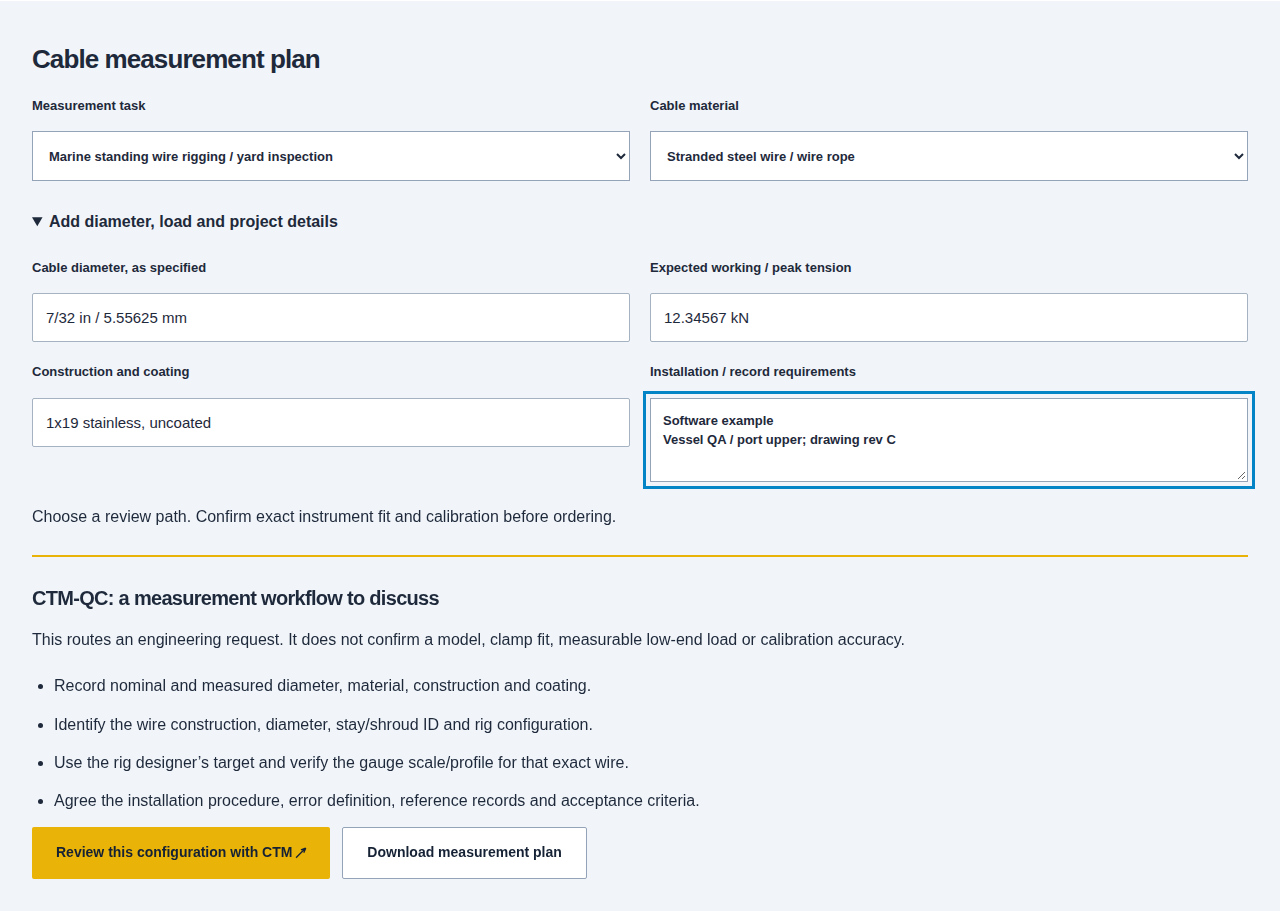
Standing-wire gauge and yard-record questions
Which rigging tension gauge should a sailboat yard choose?
Start with material, exact wire size/construction, working load band, access and record requirements. Match these to a gauge’s documented calibration and supported range before comparing price or display features.
Can the same gauge measure standing wire and solid rod?
Only if its manufacturer explicitly supports both with the required contact setup and calibration. Loos lists separate RT rod gauges; this CTM wire-rope page does not approve rod use.
Does a Loos scale number mean pounds of tension?
Interpret it using the exact model, supported wire-size column, chart and units. A scale number is not a universal force value or a cross-brand conversion.
Are PT-2 and PT-2M simply the same size list?
The cited instructions list specific imperial and metric wire sizes. For example, 7/32 in converts to 5.55625 mm, but that arithmetic does not select a 5 mm or 6 mm calibration.
Can I use a 7x19 profile for 1x19 stainless wire?
Do not assume it. Diameter, construction, material and contact geometry affect the deflection response. Obtain explicit supported-profile or calibration evidence for the actual wire.
What percentage of breaking strength should every rig use?
This guide provides no universal percentage. Use the particular boat/rig designer’s requirements, member identity and approved procedure.
Should port and starboard always show identical readings?
Use the designer’s requirements and comparable conditions. Matching numbers alone does not establish that mast alignment, fittings or the complete rig are acceptable.
Can I measure through a protective coating or cover?
Ask whether the actual contact setup and calibration include that material and coating. An uncoated-wire chart does not automatically cover a coated cable.
Is an old mechanical gauge record sufficient for a new digital meter?
It is useful context, but not an automatic calibration transfer. Preserve old model/table/units and review the new meter against the actual wire and required working range.
Does Bluetooth establish a complete inspection report?
No. Confirm the supported app/device versions, exported fields, units, timestamps and member/profile identification with a sample export.
Can I use the steel-wire kit on synthetic stays?
No compatibility is established here. Synthetic material and construction need a separate instrument and contact/calibration assessment.
What should I include in a yard-kit RFQ?
Include vessel/rig types, member IDs, wire material/construction/sizes, normal/peak force, access, environmental needs, record format, quantity and destination. The measurement-plan worksheet preserves your typed details.
Source scope for wire-gauge and rod decisions
Reviewed November 1, 2026. Manufacturer instructions apply to their stated model and revision; they are not CTM operating instructions or a CTM certification.
- Loos INST-07 professional wire-gauge instructions
Model-specific cable size lists, chart interpretation and manufacturer-specific tuning requirements; revision 06/18/19.
- Loos RT-11 rod-gauge product documentation
A separate rod-gauge family; no CTM cross-reference or accuracy equivalence.
- Dillon cable calibration FAQs
Individual cable calibration boundary for clamp-on measurement.
- CTM calibration guide
Force/diameter arithmetic and evidence to request; no boat-specific tuning approval.