
FOR ENGINEERING BUYERS / COMPLETE PROJECT REQUESTS
Wire rope tension measurement kits.
Plan instruments and accessories for one reviewed project quotation.
Published and reviewed November 1, 2026 · CTM Engineering
PROJECT REQUEST
Choose the main instrument.
Choose a family. Add other instruments below.
The email draft includes the current instrument requirements. Add your company, delivery country and contact details before sending.
Email CTM this request ↗Continuing replaces the engineering draft in this tab. Download an earlier request before starting another project. Personal contact details are entered on Contact and are excluded from the tab draft.
MEASUREMENT KIT SCOPE
Build around the rope and the task.
A wire rope tension measurement kit brings together a measuring instrument, matched contact parts, rope-specific calibration information and the items needed to use and transport it. Different tasks need different packages: a tower crew's portable survey kit and a permanently wired crane channel have distinct interfaces and acceptance records.
This page addresses measurement instruments. Mechanical tightening, termination and structural rigging hardware require their own specification. Before choosing a case or display, identify the actual rope, useful tension range, motion, access and accepted procedure.
Screen the five instrument families →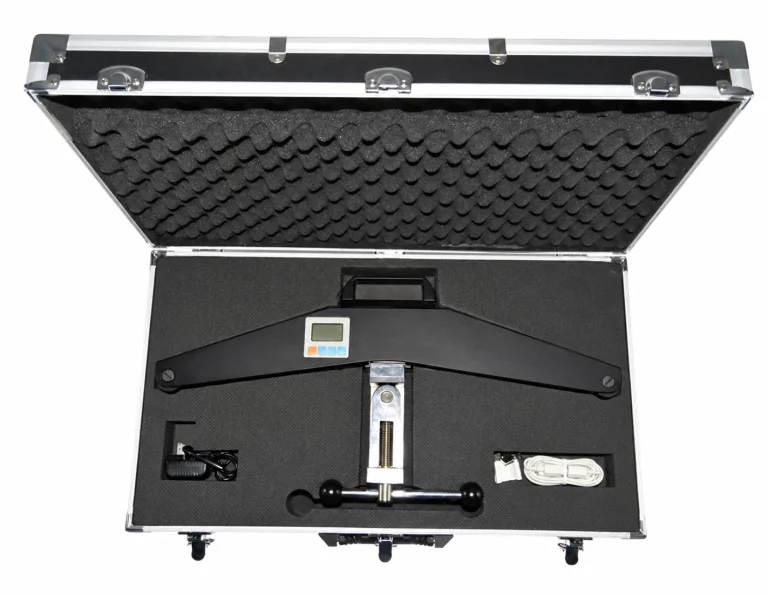
Choose the measurement task before the case.
A kit is useful when the instrument, rope profiles and workflow fit the job. The CTM families below are configuration requests with reviewed planning envelopes.
| Task | Family to review | Define the package |
|---|---|---|
| Stationary guy wire / tower survey | CTM-QC handheld | Meter, matched contact parts, rope profile list, field record format and carrying protection. |
| Permanent dead-end monitoring | CTM-FIX clamp-on sensor | Sensor quantity, transmitter, cable lengths, supply, PLC input and commissioning records. |
| Moving line / cable pulling | CTM-RLT running line | Sheave arrangement, speed and peak response; state whether length and speed channels are required. |
| Aircraft control cable | CTM-AIR compact tensiometer | Exact cable identity, access envelope, approved maintenance procedure and required calibration evidence. |
| Elevator rope comparison | CTM-ELV balancing request | Rope count, sequential versus simultaneous readings, channel accessories and OEM comparison condition. |
Turn a reference photograph into a written packing list.
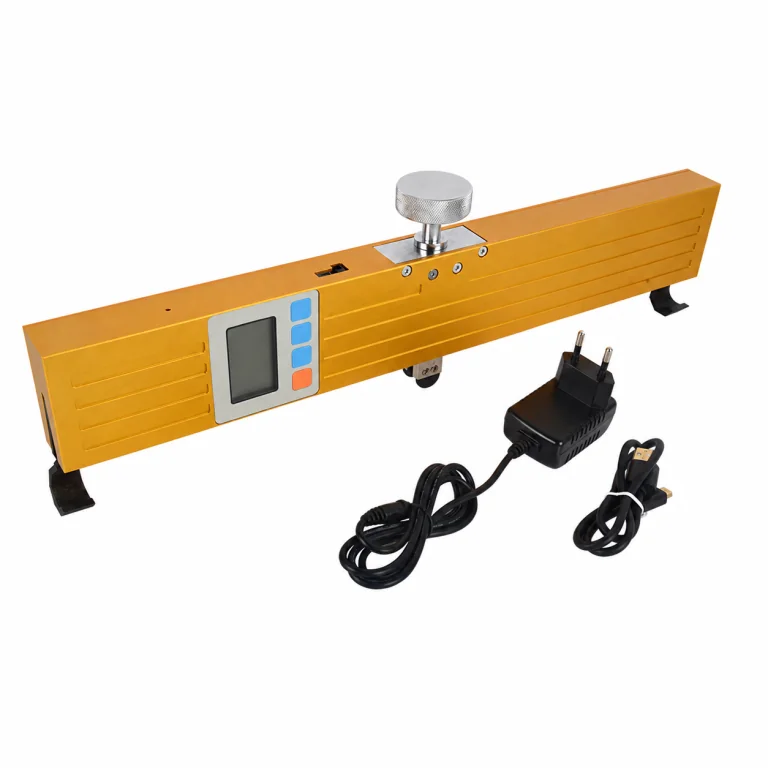
Visible accessories help identify questions. They do not establish what a quoted CTM package includes.
| Component | What to specify | Evidence in the offer |
|---|---|---|
| Instrument and contact parts | Model request, rope diameters, materials and working loads | Exact delivered configuration, compatible contact parts and profile IDs. |
| Case and transport protection | Instrument dimensions, foam layout and service access | Case identity, included items and any claimed ingress rating with supporting evidence. |
| Power and data | Destination plug, charger or battery type, cable and connector needs | Part numbers, cable lengths and accepted device/software versions. |
| Records and field check | Certificate scope, profile schedule, manual revision and check accessory | Serial-linked records and defined check method; a rod alone does not calibrate every rope. |
List the clamp parts, cables and power items.
Specify each item rather than inferring it from a case or kit photograph. Confirm lengths, connector types and final quantities in the offer.
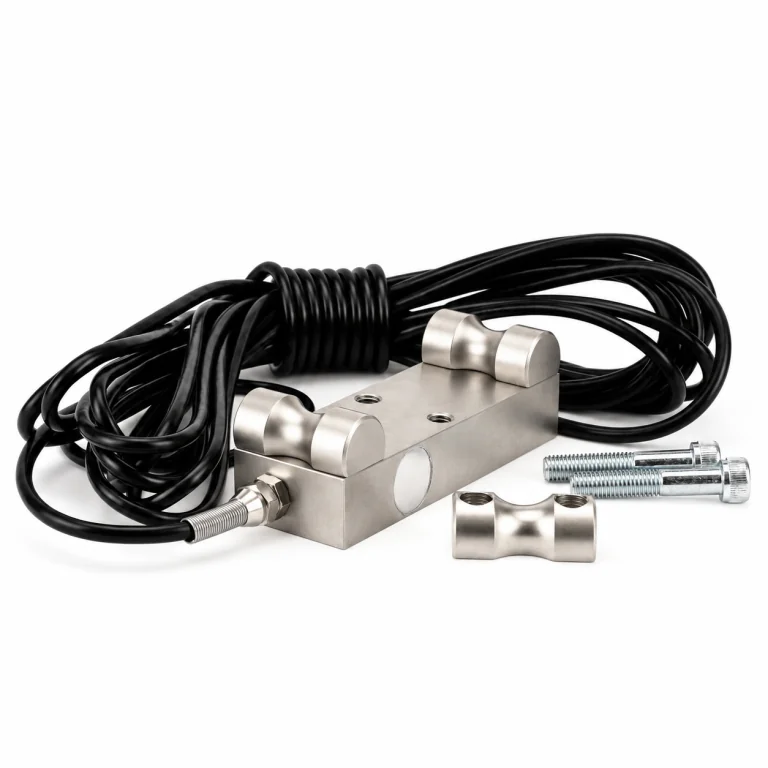
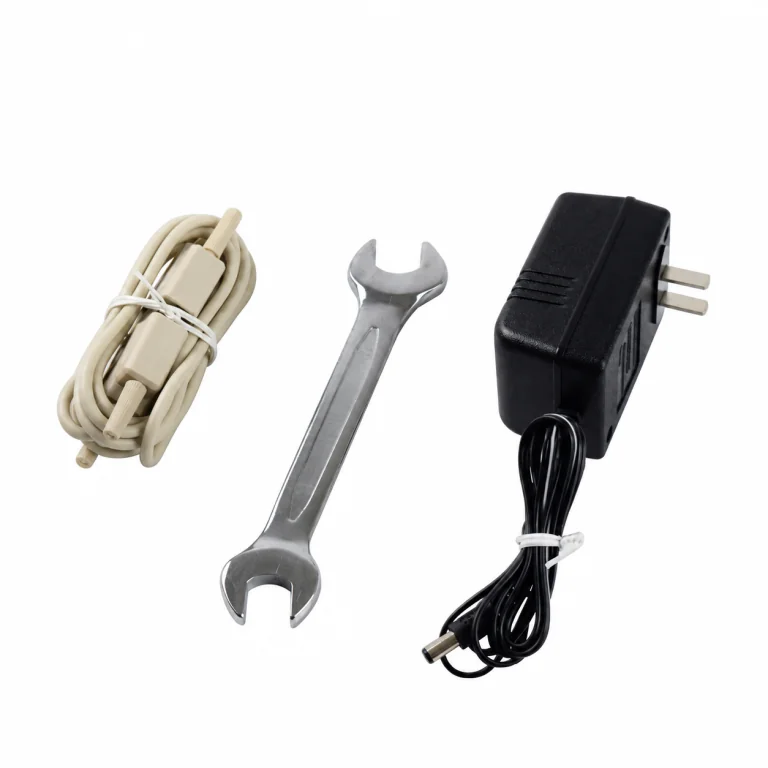
Supplier reference photographs. Exact model, rope fit, calibration and supplied accessories are agreed in the written offer.
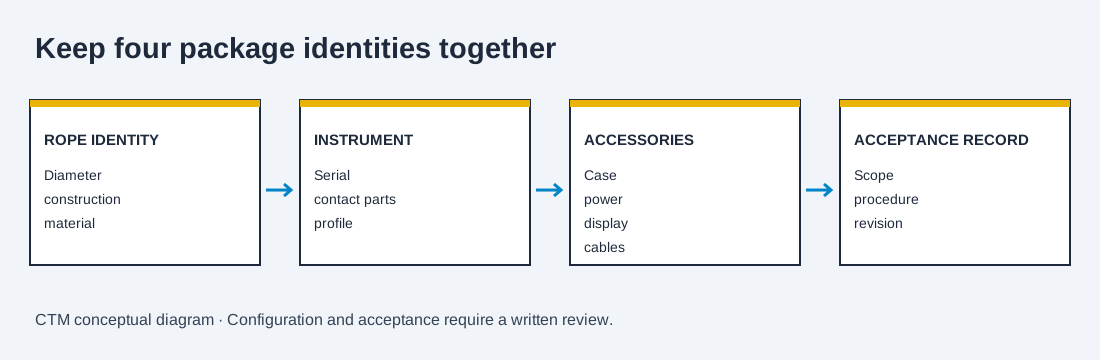
Keep the package identities connected.
A rope profile belongs to a defined instrument/contact arrangement. Record those identities with the serial number and field procedure so a replacement accessory does not quietly change the measurement setup.
Compare named packages, not an assumed universal kit.
These manufacturer examples explain why the line-item list matters. They are not CTM performance comparisons or a promise of interchangeability.
| Primary reference | Published package context | Buyer action |
|---|---|---|
| Checkline CTM2 | Lists a meter, diameter gauge, manual, certificate and heavy-duty case. | Check the exact order code, sheave set and calibrated rope identities. |
| Dillon Quick Check | Portable meter documentation and carrying-package context. | Compare the offered configuration and calibration scope, not the family name alone. |
| Crosby Straightpoint COLT | App-based readout, case and standard calibration rod; CVT inclusion wording varies between documents. | Resolve the accessory part list in writing. Confirm whether a compatible smart device is supplied. |
| CTM project request | Primary instrument plus up to five separately specified additional requests. | CTM reviews the request; only the written offer releases a configuration and defines inclusions. |
Count instruments, ropes and profiles separately.
These three counts answer different questions. Do not order eight elevator kits when the installation has eight ropes.
| Count | Illustrative request | Question to resolve |
|---|---|---|
| Instrument / kit quantity | Two crew kits | How many independently usable sets are needed at the same time? |
| Elevator rope count | One kit for six ropes | One meter moved sequentially, or six sensors/channels read together? |
| Calibration profile count | Three distinct diameter/construction/material combinations | Which profile belongs to which delivered instrument and rope ID? |
| Shared accessory quantity | One case or display proposed for several sensors | Can it actually be shared during the intended workflow? Specify the final quantities in the offer. |
Separate accessory requests from complete project cost.
The site shows indicative option budgets, not a released instrument or complete project price. The planner does not add a project total.
| Budget line | Current indicative option | Quotation boundary |
|---|---|---|
| Rope-specific profiles | +$95 USD request for up to 15 profiles | Confirm the actual cable list, factory support, included count and any sampling requirement. |
| Case / check accessories | +$85 USD request | Confirm exact case, gauge and verification accessory; remove duplicate charges for base inclusions. |
| Wireless / remote readout | +$165 USD compatibility review | Confirm supported delivered hardware, app/device versions and accessories. |
| FIX alarm box | +$150 USD request | Only offered for CTM-FIX review; define power, signals, relays and commissioning scope. |
| Project purchase | Written quotation required | Instrument quantities, calibration, accessories, shipping, tax, destination terms and service. |
Specify how the crew will compare several ropes.
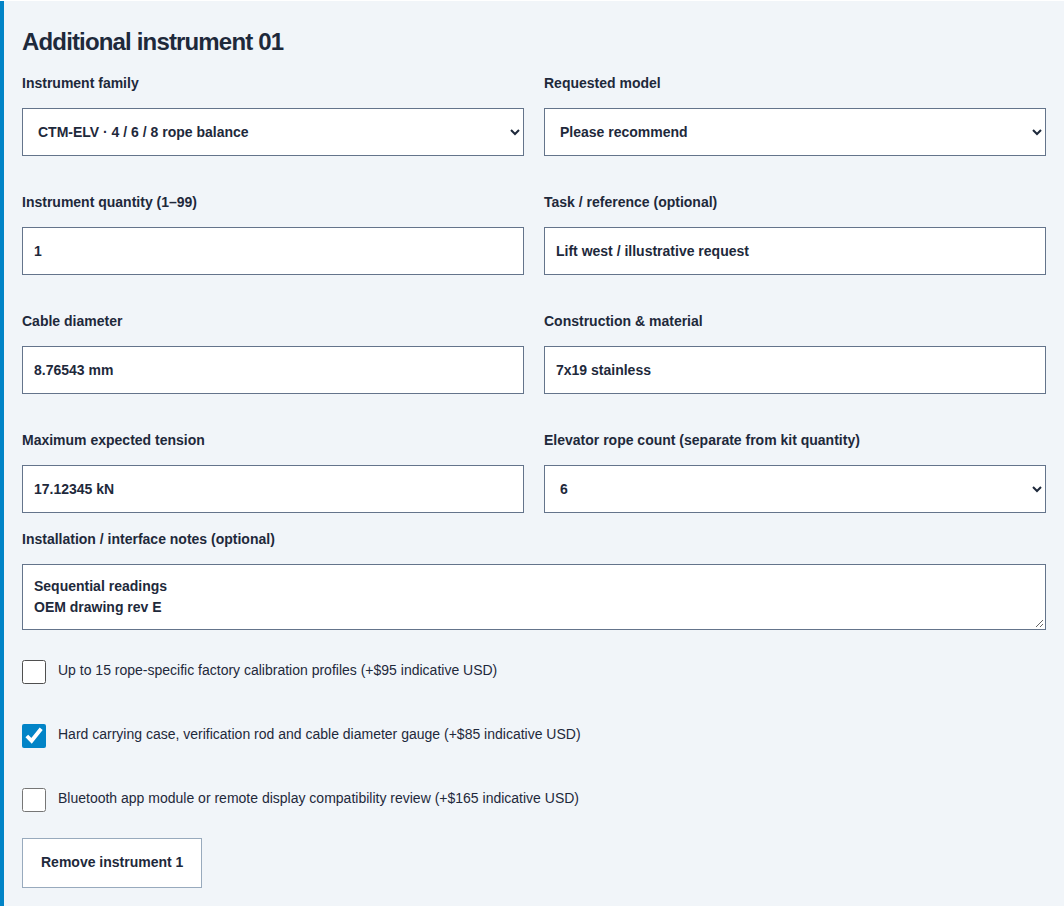
For an elevator balancing kit, the number of ropes does not decide the number of complete instruments. State whether one meter will be moved sequentially or several channels must be read together. The intended comparison condition and accepted balance criterion come from the equipment's approved procedure.
The request planner keeps elevator rope count separate from instrument quantity. It does not authorize elevator adjustment or create a universal balance limit.
Review CTM-ELV requests and comparison tools →Three ways to write a clearer project brief.
These are illustrative procurement scenarios, not customer projects, approved combinations or field results.
Two tower crews, three rope identities
Illustrative brief: two independently usable handheld sets; three diameter/construction/material combinations across the sites.
Primary quantity 2 is an instrument count. List each rope in the calibration schedule on Contact. Ask whether each set contains all three profiles, its own contact parts and a case; confirm the reporting workflow.
One six-rope elevator installation
Illustrative brief: one balancing project, six ropes, a documented condition for comparison.
Request one CTM-ELV kit and enter rope count 6. Specify sequential or synchronized readings and the accepted OEM comparison method. Six ropes do not automatically mean six complete kits.
Permanent monitoring plus a portable survey meter
Illustrative brief: three fixed monitoring points and one portable instrument for a separate inspection task.
Use CTM-FIX primary quantity 3, with supply, receiver and alarm needs in notes. Add one CTM-QC request with its own rope/load details. Treat the portable reading as a separate method; do not assume it validates the installed channel.
Review the complete list before sending.
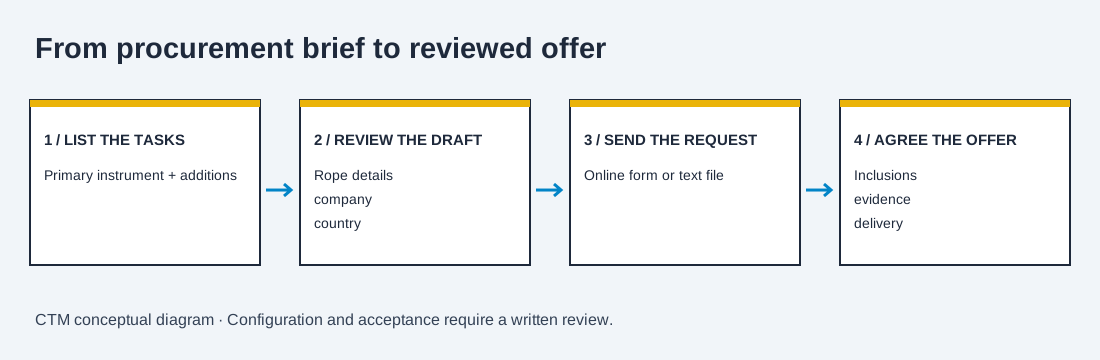
- Define each task. Choose the primary family and quantity; add different rope or interface requirements on separate instrument lines.
- Continue to Contact. Review the transferred draft, add your company and destination, and complete any missing rope details. Name, email and company stay outside the tab draft.
- Preserve the complete request. Download a text copy. A long-request email link opens a cover note and requires the file attachment. If storage fails, the planner stays here with your entries and recovery instructions.
- Approve the written offer. Reconcile instrument quantities, shared accessories, rope profiles, calibration scope, delivery and service. A submitted request is not an approved product configuration.
A visible request you can check.
Agree acceptance and support before dispatch.
Use the same acceptance list when comparing offers and receiving the shipment. A polished case is not a calibration record.
| Before order | At receipt / commissioning | Service question |
|---|---|---|
| Approved configuration and packing list | Match serials, contact parts, profiles and accessory quantities to the offer. | How are a lost adapter, damaged case or replacement cable identified? |
| Calibration range and evidence | Review the certificate, rope identity, units, conditions and stated uncertainty/error basis. | Where is recalibration performed, what must be returned and what turnaround is actually quoted? |
| Readout / interface acceptance | Use the agreed device or receiver and record software / parameter revisions. | Who supports updates, replacement displays and configuration backups? |
| Delivery and trade terms | Inspect packaging and document discrepancies through the agreed process. | Confirm country, Incoterm, freight, duties, warranty route and return arrangements in writing. |
Discuss the list with CTM engineering.
Use the planner to preserve line-by-line requirements, or ask for help choosing the measurement method. The engineering review must establish exact fit and performance before a configuration is offered.
Measurement kit questions
What does a wire rope tension measurement kit include?
There is no universal contents list. Request the instrument, compatible contact parts, rope profiles, display or interface, power items, case, manual and calibration records as individual lines. The written offer defines the CTM package.
Does this kit tighten or terminate the wire rope?
This page covers instruments that measure rope tension. Mechanical tensioning and termination hardware require a separate design and supply specification. Measuring tension does not establish the load capacity of the rope assembly.
Can I request several instrument families together?
Yes. Choose the primary family and add up to five additional instrument requests. Each additional line keeps its own quantity, rope details, model request, options and notes. The engineering team must review the final arrangement.
Do I need one profile for every cable diameter?
Diameter alone is insufficient. Identify construction and material as well as the intended working range. Ask which distinct combinations need calibration and which contact parts apply. Use the rope profile schedule on Contact to preserve the actual list.
Does a case photograph prove the package is included?
No. Supplier reference photographs show examples for identification. Confirm the exact case, contents, dimensions and any protection claim in the written offer.
Is a verification rod the same as rope calibration?
No. A defined field check can help assess an instrument response in its stated setup. It does not establish calibration across every rope diameter, construction, material and load range. Request the method and acceptance criterion for the delivered accessory.
Is the smartphone included in a Bluetooth kit?
Confirm this explicitly. Ask for the readout hardware, supported device and OS/app versions, licensing, export format and connectivity acceptance test. A Bluetooth option request does not establish an available CTM app.
Does one elevator kit mean one channel?
Not necessarily. State the number of ropes and whether readings are sequential or simultaneous. Instrument quantity counts usable sets; rope or channel count describes the arrangement within each set.
Is the selected accessory budget the project price?
No. The RFQ labels its accessory estimate as primary-instrument only. A multi-instrument request needs line-by-line instrument, accessory, calibration and delivery prices. The planner deliberately provides no aggregate project price.
Can I save an incomplete procurement list?
Continue to Contact with a partial draft, then finish the required rope, company and destination fields before online submission. The draft stays in the same browser tab. Download it before replacing it with another project.
What happens if browser storage is unavailable?
The planner stays on the page and shows recovery instructions. Download the complete request text and attach it to your email. For long requests, the email link contains only a cover note; the download contains the complete list.
Are model codes approved or stocked products?
The CTM codes on this site identify configuration requests and planning envelopes. Exact geometry, calibration, performance, inclusions, price, availability and dispatch date require a reviewed written offer.
Sources and review boundaries.
Reviewed November 1, 2026 by CTM Engineering. Primary manufacturer documents inform the procurement questions above. Named brands retain their trademarks; CTM is independent. Package descriptions can change and do not establish CTM compatibility or inclusions.
- Checkline CTM2: complete kit and calibration
Names a meter, wire diameter gauge, manual, certificate and carrying case. Requires calibration for each diameter/construction/material. These are CTM2 statements, not CTM inclusions; the page has inconsistent extra-calibration prices, which we do not use.
- Dillon Quick Check: product and documents
Reference for a portable measurement package and rope-specific selection. Dillon and the related Checkline platform are not independent comparative test results.
- Kito Crosby COLT: listed accessories and readout
Describes app-based readout, a purpose-made case and a standard calibration rod. Its CVT wording differs from the 2025–2026 catalog; ask for exact accessory part numbers and inclusion status.
- Kito Crosby 2025–2026 metric catalog
COLT catalog page 54 distinguishes a standard calibration rod from optional CVT. A field check and rope-specific calibration are separate procurement questions. No competitor specification is transferred to CTM.
Hardware-specific accuracy, ingress protection, certification, app support, stock, dispatch, warranty and service commitments remain subject to supplier evidence and the written offer. This guide does not provide a safe working load or replace an approved installation procedure.