
Aircraft Cable Tensiometer Data Recording
Compare your entered limits and export an unsigned review draft.
Record one reading
Compare entered limits. Export an unsigned draft. * Required.
1. Decide what the record can establish
A useful measurement handoff separates the observation, its source evidence and the later authorization. This tool helps prepare the first two for human review. Its required fields are a worksheet design, not a universal statutory schema.
| Decision | Basis | Limit |
|---|---|---|
| Keep measurement evidence separate from release authorization. | 14 CFR 43.9 ↗ | A typed license ID does not sign this draft. |
| Check instrument/profile evidence as well as the due date. | 14 CFR 145.109(b)–(c) ↗; T5 SOP-TN-001 Rev.25, §§3-1 and 6-3 ↗ | The date check does not verify certificate validity or calibration scope. |
| Plan record controls beyond the export file. | FAA AC 120-78B, issued 2024-12-11 ↗ | Local files have no controlled amendment or authentication service. |
| Validate the receiving interface before importing. | ATA e-Business standards catalog ↗ | The draft is a CTM field layout, not an ATA or vendor format. |
2. Cable-ID and maintenance-task data schema
Use one draft per cable, location and measurement event. A repeated measurement should retain its own source identity in the receiving system; replacing a browser value is not an amendment trail. Dates use YYYY-MM-DD, and the future-date check uses the current UTC date.
| Group | Capture here | Verify or add in the controlled record |
|---|---|---|
| Aircraft and task | Registration, model, work order, AMM task/revision, control circuit | Task applicability, completion description, aircraft-specific identifiers and any required additional data. |
| Cable and profile | Cable ID, diameter, construction, coating, riser/contact ID, profile reference | Exact calibration scope, location and serial-matched conversion card or digital profile. |
| Observation | Temperature and unit; entered min/nominal/max; reading and force unit | Temperature-specific limits, original scale indication if applicable, source precision and measurement method. |
| Equipment | Model, serial, entered calibration due date, measurement date | Certificate ID and scope, serviceability, and any intervening events affecting validity. |
| Procedure context | Optional span and thread count; reported conditioning and safety method | Applicable procedure steps, independent checks and applicability of hardware fields. |
| People | Technician ID; optional inspector ID | Authorized names, authenticated signature, completion date and release entry as applicable. |
3. Units and profile audit checklist
Compare only like quantities. A dial scale indication is not automatically a force reading. Complete the required conversion using the applicable instrument documentation before entering measured force. The tool does not interpolate calibration cards.
| Check | Evidence to keep | If missing |
|---|---|---|
| Force unit | Original value and unit; limits in their documented unit; reading in its own documented unit | Resolve the unit before using the comparison. |
| Force conversion | 1 lbf = 4.4482216152605 N; 1 daN = 10 N; 1 kgf = 9.80665 N | These are unit definitions, not instrument accuracy claims. Review rounding against source resolution. |
| Cable profile | Diameter, construction and jacket condition | Request a matching calibrated profile; do not borrow another cable curve. |
| Contact and card | Instrument model, serial, contact/riser and card revision | Check the matched documentation; diameter alone does not select the contact. |
| Temperature | Temperature at the documented location and applicable limits | No universal thermal slope or hangar acceptance range is supplied. |
The linked T5 SOP-TN-001 Rev.25, §§3-1 and 6-3 ↗ requires correct riser selection and a serial-matched calibration card. Its cable-specific calibration discussion supports documenting the profile, not transferring a T5 setup to another instrument.
4. Placement, temperature and mechanical evidence
This page supplies no universal span minimum, control-cycle count, exposed-thread limit or coating correction. Record what was observed, then check the applicable aircraft and instrument procedures. A span entry triggers evidence review, not a calculated geometry correction.
The conditioning checkbox and safety-method selection are user reports. They do not prove correct control position, locking, thread engagement or independent inspection. Leave unsupported items unresolved. If a field is inapplicable, document that determination in the controlled record rather than selecting a verified state for convenience.
Thermal effects depend on the complete installation, materials and compensation provisions. The tool checks a numeric temperature for basic plausibility but does not approve it for rigging. Public evidence does not establish the appropriate limits for your particular aircraft task.
5. Electronic-record controls outside this browser
FAA AC 120-78B, issued 2024-12-11 ↗ describes guidance for electronic systems. Following a field layout does not implement that system. The draft deliberately carries no purported SHA-256 digest or electronic signature.
| Control | This tool | Receiving workflow |
|---|---|---|
| Identity and intent | Stores typed reference IDs | Authenticate authorized personnel and record deliberate signing. |
| Integrity and amendments | Editable session values and draft exports | Protect accepted records and retain controlled corrections/history. |
| Retention and availability | Session storage and user download | Apply the relevant retention, backup, retrieval and access policies. |
| Document evidence | Records references and user dates | Verify actual source documents, applicability and certificates. |
6. Five bounded worked cases
All cases are fictional training data, not aircraft limits, real maintenance events, product specifications or released work. Load a case above to reproduce its arithmetic or evidence state. Edits retain the fictional label until the form is cleared.
Case 1: Within entered limits
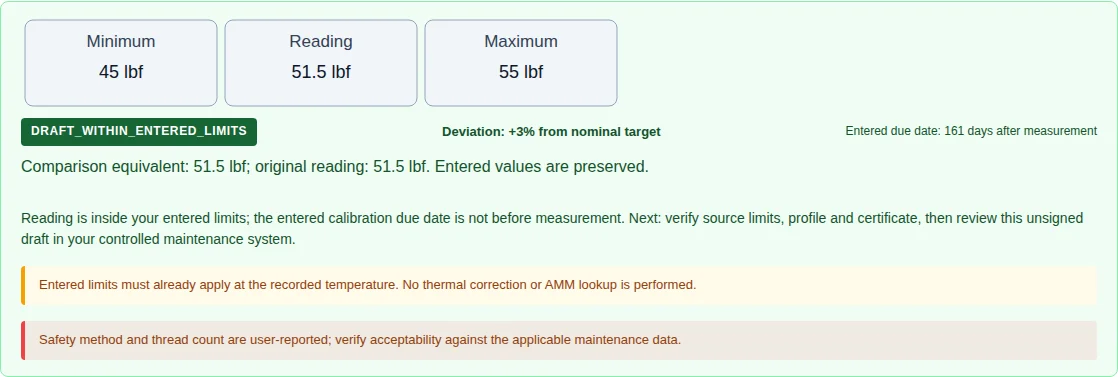
Premise: 45–55 lbf, reading 51.5 lbf; measurement 2026-11-05; entered due date 2027-04-15.
Process and result: 51.5 is inside the illustrative 45–55 lbf band, +3.0% from the entered nominal 50 lbf. This arithmetic does not verify the limits, procedure, instrument suitability or authorization.
Next action: Verify all source evidence before controlled review.
Case 2: Above entered limits
Premise: 70–80 lbf, reading 92 lbf; measurement 2026-11-05; entered due date 2027-04-15.
Process and result: 92 lbf exceeds the illustrative maximum of 80 lbf by 12 lbf (15% of that maximum). The tool cannot diagnose the cause. Record the discrepancy and consult the applicable procedure before any adjustment.
Next action: Preserve the discrepancy and follow the applicable procedure.
Case 3: Calibration date expired
Premise: 45–55 lbf, reading 51.5 lbf; measurement 2026-11-05; entered due date 2026-10-15.
Process and result: The entered due date precedes the measurement date by 21 days. Retain the result as a discrepancy draft and ask quality staff to assess equipment status and affected work; the browser does not determine legal validity.
Next action: Ask quality staff to assess equipment status and affected work.
Case 4: Span evidence to review
Premise: 45–55 lbf, reading 51.5 lbf; measurement 2026-11-05; entered due date 2027-04-15.
Process and result: An illustrative 18.5-inch span is recorded for review. No universal minimum or correction is applied; obtain the instrument and aircraft procedure requirements before accepting the measurement.
Next action: Resolve placement or coated-profile evidence before acceptance.
Case 5: Jacketed profile to review
Premise: 45–55 lbf, reading 51.5 lbf; measurement 2026-11-05; entered due date 2027-04-15.
Process and result: A coated cable requires matching instrument/profile evidence. An in-band number alone cannot establish suitability; record the jacket condition and ask for configuration-specific confirmation.
Next action: Resolve placement or coated-profile evidence before acceptance.
7. Export validation example and acceptance steps
Text, JSON and CSV carry the entered fields, fictional/user source marker, draft notice, field errors, review warnings and next action. Empty forms cannot be exported. Incomplete drafts can be exported to request missing evidence, with their invalid status retained.
| Test | Expected local output | Acceptance check |
|---|---|---|
| Load case 1 | 51.5 lbf inside 45–55 lbf; +3% versus entered nominal 50 | Confirm fictional marker and unsigned notice survive mapping. |
| Enter a reading in N with limits in lbf | Raw values stay unchanged; comparison uses the equivalent reading | Confirm each source unit and equivalent before acceptance. |
| Clear the nominal | No nominal deviation; no inferred midpoint | Receiving field stays unknown, not zero. |
| Load case 2 / case 3 | Outside limits / expired entered due date | Preserve discrepancy flags and review instructions. |
| Export and reconcile | Text, local-format JSON and one CSV row | Compare every raw input, error, warning and unit with the draft. |
| Approve mapping | No vendor adapter or API supplied | Use a nonproduction import and qualified review before production use. |
CSV cells are quoted and escaped. Potential spreadsheet formula cells are prefixed with an apostrophe; the receiving system may need to handle that visible prefix. Use JSON for exact original string values. Neither output is claimed compatible with CAMP, Trax, AMOS or an ATA schema.
8. Choose a recording method
| Method | Useful when | Cost or reliability tradeoff |
|---|---|---|
| Controlled paper worksheet | No suitable electronic workflow is available | Manual transcription and filing effort; retain the required source and authorization evidence. |
| This local draft | Prepare one record or a configuration inquiry | No instrument connection or approval; manual entry and controlled-system handoff remain. |
| Instrument data capture | An ordered and verified interface is available | Profile, unit and task mapping still need validation; confirm model-specific outputs. |
| Integrated MRO workflow | Multiple roles need controlled record handling | Configuration, adapters, training and verification require project-specific effort. |
The Tensitron ACX manufacturer page ↗ is a manufacturer reference for its own instrument. CTM interfaces, calibration profiles and data capture options require written confirmation for the quoted configuration.
9. Risks, mitigations and practical alternatives
Misuse risk: an in-band number can hide incorrect limits, a mismatched cable profile or unresolved mechanical condition. Preserve supporting references and route the draft to qualified review. If evidence is missing, export the discrepancy and request it before acceptance.
Cost risk: choosing hardware before agreeing profiles and export requirements can create rework, additional calibration or integration effort. Request a sample output and a written scope; no price, lead time or certification is established here.
Scenario mismatch: batch capture, instrument communications, multi-location history and authenticated signatures need a separate controlled workflow. Use your approved worksheet or MRO process while confirming integration. A quote request can carry the draft, but cannot approve its maintenance content.
10. Source ledger, dates and limitations
Public sources reviewed 2026-11-05. Regulatory applicability and current aircraft/instrument revisions must be checked for the actual task. The local schema, example limits and interface checklist are editorial workflow aids; no private AMM or vendor import specification was verified. Review this guide by 2027-05-05, or sooner if a cited rule, manual, interface or the tool behavior changes. Public deployment dates have not been verified; the creation date above is the first repository record.
| Source | Supported scope |
|---|---|
| 14 CFR 43.9 ↗ | Maintenance record content: work description/reference, completion date, and applicable personnel/signature information. A browser draft is not a signed entry. |
| 14 CFR 145.109(b)–(c) ↗ | Repair-station tools used for airworthiness determinations require calibration to an FAA-acceptable standard and appropriate equipment. A due-date comparison cannot establish this. |
| FAA AC 120-78B, issued 2024-12-11 ↗ | Guidance on electronic signatures, records and manuals; an acceptable means rather than a mandatory rule or product certification. |
| T5 SOP-TN-001 Rev.25, §§3-1 and 6-3 ↗ | Riser and serial-matched card selection; calibration on the cable type used. This linked revision is not proof of the current manual for a supplied instrument. |
| Tensitron ACX manufacturer page ↗ | Example of digital instrument configuration evidence; confirm ordered profiles and output options. No CTM capability equivalence is implied. |
| ATA e-Business standards catalog ↗ | Spec 2000: chapter 16 covers authorized release certificates, 17 electronic logbooks, and 18 electronic work packages. Local JSON is not an implementation of those standards. |
11. Questions about evidence and handoff
Purpose: What does this aircraft cable tensiometer data recording tool do?
It organizes one measurement, compares it with limits you enter, checks the entered calibration due date against measurement date, and exports an unsigned review draft. It does not read instruments or retrieve AMM curves.
Limits: Does an in-range result authorize maintenance release?
No. The limits, instrument suitability, procedure completion and personnel authorization remain unverified. Review the draft in your controlled maintenance system.
Inputs: Where do the minimum and maximum values come from?
Use the applicable current maintenance data at the recorded temperature and condition. Keep its task and revision reference. If those limits are unavailable, leave them missing and request review.
Inputs: How are different reading and limit units compared?
Select the original unit for the limits and separately for the measured value. Selectors do not rewrite raw entries. The comparison converts the reading to the limit unit; check source precision before acceptance.
Inputs: Is a nominal tension required?
No. Without an explicit nominal the draft records no nominal deviation. It does not invent a nominal from the range midpoint.
Evidence: Does the calibration date prove the meter is suitable?
No. The calendar check cannot verify a certificate, its scope, the matching serial number, intervening damage or profile compatibility. Those need documented review.
Evidence: Can a coated cable use the bare-cable profile?
Do not assume equivalence. Obtain a profile and contact configuration calibrated for the cable used. This tool does not calculate coating compensation or prescribe removing a jacket.
Evidence: Is there a universal 36-inch span or three-cycle requirement?
This page does not establish one. Record placement and conditioning from the applicable aircraft and instrument procedures; a generic number cannot replace them.
Export: Are the text and CSV files electronic signatures?
No. Typed personnel IDs are reference fields. The files contain no authenticated signature, cryptographic digest, controlled amendment history or archival service.
Export: Can I import this JSON directly into AMOS, CAMP or Trax?
No tested adapter or vendor schema is supplied. Agree a mapping, test units and mandatory fields, and reconcile a sample in a nonproduction environment before any import.
Recovery: What if the reading is outside the entered limits?
Preserve the discrepancy, verify the source limits and instrument/profile evidence, and use the applicable maintenance procedure for the next action. The page does not instruct mechanical adjustment.
Recovery: Where are inputs saved and what happens if storage fails?
Inputs are saved in this tab’s session when available. Download a draft for retention. Clipboard and inquiry failures show recovery guidance; blocked storage is not an archive.
Examples: Can the example values be used on an actual aircraft?
No. Every case is fictional, including references, instrument IDs and personnel IDs. The fictional marker persists when a case is edited or reloaded. Clear all inputs before starting a real draft.
Purchasing: Which CTM outputs and aircraft profiles are confirmed?
This page does not confirm configuration-specific profiles, digital interfaces, approvals, lead times or MRO integration. Ask CTM for written confirmation with your cable and workflow evidence.
12. Request a configuration review
The inquiry action carries the full draft, including aircraft/task references and personnel IDs, to the contact form for your review before submission. Remove unnecessary sensitive details first. It preserves existing inquiry fields and stops if storage fails or the combined summary exceeds 3,000 characters. Download the full draft as the alternative.
Include cable construction and coating, applicable task evidence, desired export format and receiving-system requirements. CTM Rigging & Force Instruments will need to confirm suitable profiles, interfaces, calibration scope and availability for the proposed configuration.
Or email [email protected] with your downloaded draft.